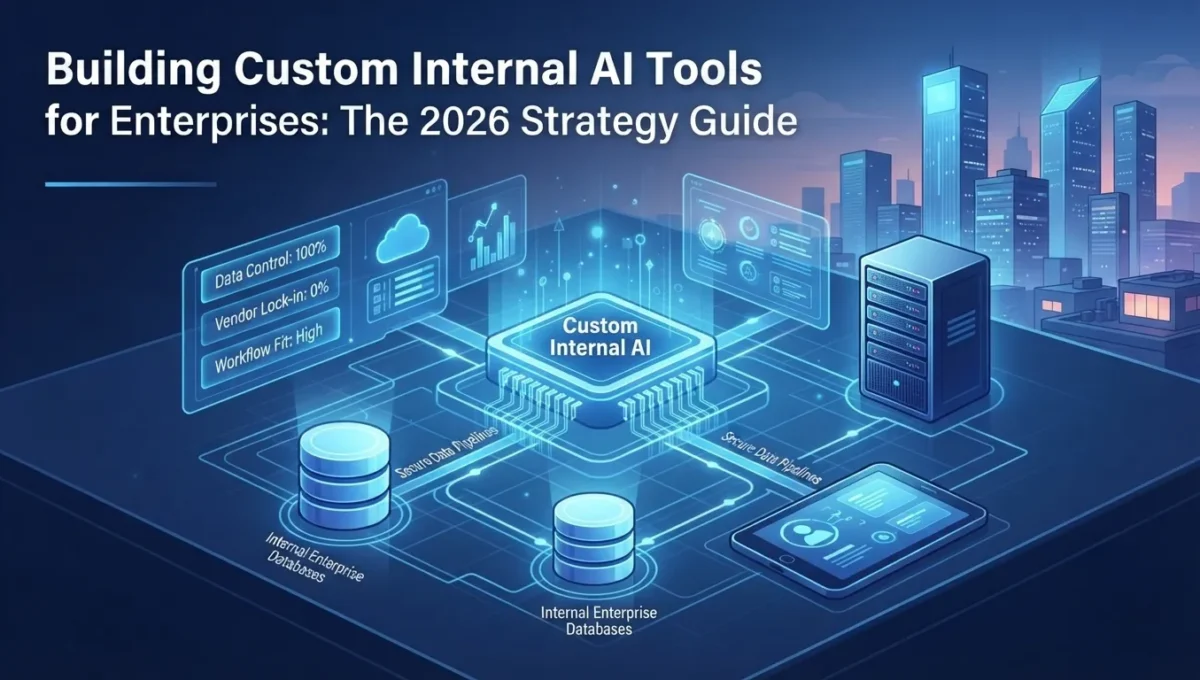
| Quick Answer: Building custom internal AI tools for enterprises means creating private, workflow specific AI systems that keep your data inside your own infrastructure , unlike generic SaaS AI tools that send data to third party servers. The result is stronger data control, no vendor lock in, and AI that actually fits how your team works. |
Every enterprise has tried a generic AI tool and hit the same wall: it does not understand your data, your workflows, or your compliance requirements. Building internal AI tools for enterprises solves this problem at the root. Instead of bending your processes to fit a vendor’s product, you build AI that fits your business exactly.
This guide is a blueprint for CTOs and Engineering Leads. It covers the architecture decisions, security requirements, phased build roadmap, and cost controls that turn an AI idea into a production system. Every section addresses gaps that most competitor guides skip entirely.
The State of Enterprise AI: Why “Build vs. Buy” is the New Dilemma

Off the shelf AI tools are fast to deploy but carry a risk most procurement teams underestimate: vendor lock in. When a vendor changes its pricing, deprecates a model version, or suffers a data breach, your entire AI dependent workflow stops. Building Internal AI Tools for Enterprises removes this single point of failure entirely.
| Factor | Off the Shelf AI | Custom Internal AI Tool |
| Data control | Data leaves your servers | Stays within your infrastructure |
| Vendor lock in | High pricing changes hurt | None , you own the stack |
| Custom workflows | Limited to vendor features | Built around your exact process |
| Security compliance | Vendor managed (risky) | Your policies, your controls |
| Long term cost | Subscription scales with users | Fixed infra + one time build cost |
| Model updates | Vendor decides timeline | You control upgrade schedule |
The build decision is not just about control , it is about long term cost predictability. A custom system has a one time build cost and stable infrastructure expenses. A SaaS AI product bills per seat, per API call, or per model update , and those costs scale directly with your team size.
Architectural Pillars: What Every Custom AI Tool Needs

A production grade custom AI system needs three core components working together. Without all three, Building Internal AI Tools for Enterprises produces a demo, not a deployable product.
RAG (Retrieval Augmented Generation) , Simply Explained

RAG is the technique that makes an AI tool answer questions using your company’s actual data instead of just its general training. Think of it this way: the AI is the brain, and your company documents are a searchable library it can reference before answering. It retrieves the relevant documents first, then generates an answer grounded in that specific content.
- Without RAG: the model guesses from general knowledge and produces hallucinations
- With RAG: the model reads your policy document, contract, or database record before responding
Vector Databases: The Memory Layer

A vector database stores your documents as mathematical representations (embeddings) that the AI can search by meaning, not just keywords. When a user asks a question, the system finds the most semantically similar documents in milliseconds and feeds them to the model. This is the backbone of any enterprise RAG pipeline and a non negotiable component when Building Internal AI Tools for Enterprises at scale.
| Enterprise Checklist Architecture: Ensure your AI stack includes: (1) an LLM for generation, (2) a vector database for document retrieval, (3) an orchestration layer to manage queries, (4) an API gateway with rate limiting, and (5) logging for every model input/output pair. |
Data Governance & Security: The “Hidden” Enterprise Requirement

This is a critical area of analysis that many competing resources fail to address.
Data governance is not optional when building Internal AI Tools for Enterprises , it is the reason you are building custom instead of buying off the shelf in the first place.
Public API vs. Private LLM Hosting

Calling a public LLM API (sending your company’s data to an external server) creates a data leakage risk. For enterprises handling contracts, HR records, or financial data, this violates most internal security policies. The safer path is self hosting an open weight model (such as Llama 3) on your own cloud infrastructure via AWS or Azure. Your data never leaves your environment.
- Public API: fast to build, low cost , but data leaves your servers on every query
- Private hosting: higher infrastructure cost , but full data sovereignty and compliance
PII Masking Techniques

Before any document reaches the AI model, a PII masking layer should strip or replace personally identifiable information , names, emails, national ID numbers, and financial data. This is done in the pipeline before the retrieval step, so even if an output is logged or audited, it contains no raw personal data. This one requirement alone separates a prototype from a production enterprise deployment.
| Want to learn how to build and deploy these pipelines yourself? Skill up with Dollar Tech courses |
Step by Step Roadmap to Build Your Custom AI Tool

This four phase roadmap is the practical framework for building Internal AI Tools for Enterprises from zero to production. Each phase has a clear output so leadership can track progress without getting lost in technical detail.
Phase 1: Problem Identification & ROI Mapping

Choose one internal workflow where manual effort is highest and data is already structured. Map the time cost per week, multiply by the number of people doing the task, and set a measurable baseline. This ROI number justifies budget and gives you a success metric at launch.
- Identify the highest friction repetitive workflow
- Quantify weekly hours lost across the team
- Establish a measurable objective, such as: “streamline this process to require only 20 minutes of work per week, down from four hours”.
Phase 2: Tech Stack Selection

Match the tool’s complexity to the team’s technical capacity. No code solutions are ideal for document based question answering applications that do not require complex, customized business logic.
Low code frameworks suit workflow automation with conditional branching. Full stack builds suit systems needing deep integration with internal databases, ERP, or CRM.
Phase 3: The “Human in the Loop” Integration

No enterprise AI tool should operate fully autonomously at launch. Build a review layer where a human can approve, reject, or correct AI outputs before they become system of record actions. This is especially critical when building custom internal AI tools for enterprises in regulated industries like finance, healthcare, or legal.
Phase 4: Deployment & Scaling

Deploy to a staging environment first with 5 to 10 internal users. Collect feedback on output quality and response latency. Fix retrieval gaps before rolling out to the full organization. Autoscaling rules should be set based on the staging load data, not assumed benchmarks.
| Ready to build your first AI powered internal tool? Start with our training: Skill up with Dollar Tech courses |
Mitigating Shadow AI & Managing Internal Adoption

Shadow AI is the use of unauthorized AI tools by employees without IT knowledge. This is the highest priority risk gap that most building Internal AI Tools for Enterprises guides completely ignore. Employees paste proprietary data into consumer Chat GPT accounts because the official enterprise tool does not exist or is too slow. You solve this problem by building a better internal alternative , not by issuing a policy memo.
- Audit browser extension logs and proxy traffic to detect external AI service calls from company devices
- Survey teams anonymously to identify which workflows they are using consumer AI for today
- Build those workflows first , adoption happens naturally when the internal tool solves the actual pain point
- Set usage analytics on your custom tool to measure adoption rate weekly and catch disengagement early
Cost Optimization: Calculating TCO (Total Cost of Ownership)

Most teams underestimate the ongoing operational cost when building Internal AI Tools for Enterprises. The table below gives realistic ranges and the specific lever you can pull to reduce each cost category.
| Cost Item | Estimated Range | Optimization Lever |
| LLM API consumption | $200 to $4,000/month | Implement request caching to avoid redundant processing, and utilize lightweight, cost effective models for straightforward operations. |
| Self hosted model infra | $600 to $3,000/month | Spot/reserved instances; auto scale down at night |
| Vector database storage | $50 to $500/month | Prune stale embeddings quarterly |
| Developer build time | $15,000 to $60,000 one time | Low code for 60 to 70% of workflows |
| Ongoing maintenance | $2,000–$8,000/mo | Document every pipeline; reduce tribal knowledge |
The most common cost mistake is using a large frontier model for every query. A well architected system routes simple queries to smaller, cheaper models and escalates only complex reasoning tasks to larger ones. This routing decision alone can reduce monthly API spend by 40 to 60%.
| Learn the technical skills to architect and optimize these systems: Skill up with Dollar Tech courses |
Frequently Asked Questions (FAQ)
How long does it take to build a custom internal AI tool?
A focused single workflow tool built on a low code framework can go from scoping to internal launch in 6 to 10 weeks. A full stack system with deep ERP integration typically takes 4 to 6 months. The key variable is data readiness , structured, clean data accelerates every phase of building Internal AI Tools for Enterprises significantly.
Is a custom AI tool more secure than an enterprise SaaS AI product?
Yes, when built correctly. A self hosted LLM with PII masking and internal vector storage means your data never touches an external server. Enterprise SaaS AI products, by definition, process your data on vendor infrastructure , which creates contractual, compliance, and breach exposure that a custom build eliminates entirely.
What is the right first use case for an enterprise AI build?
The best first use case is a document Q&A tool built on internal policy or knowledge base documents. It is low risk (no automated actions), delivers immediate time savings, and validates your RAG pipeline before you apply the same architecture to higher stakes workflows. Most organizations that succeed at building Internal AI Tools for Enterprises start exactly here.
| Related Guide: Technical performance is critical across all digital systems. If you manage Shopify infrastructure alongside your enterprise AI stack, this guide covers practical optimization techniques: |
→ Shopify Speed Optimization Services in Pakistan
Conclusion
The organizations that will lead in 2027 are the ones that start building Internal AI Tools for Enterprises today. Generic AI tools create dependency. Custom tools create competitive advantage. The architecture is proven, the security framework is clear, and the four phase roadmap in this guide removes the guesswork from getting started.
The next step is identifying your highest friction internal workflow and mapping its ROI. From there, the build path is straightforward. If you want to develop the technical skills to lead this build internally, our course program gives your team the exact foundation it needs.
| Start building your AI expertise today: Skill Up With Dollar Tech Courses |